

‘A tiny, tiny piano concerto with a tiny, tiny wisp of a scherzo,’ wrote Johannes Brahms jokingly in his letter to Elisabeth von Herzogenberg. It was July 1881, more than two decades after the infamous failure of his Piano Concerto No. 1 in D minor in Leipzig. At that time, perhaps even he himself had no idea what impact this tiny piano concerto would have on his career.
The composer appeared to take the booing his Piano Concerto in D minor was met with in his stride. ‘I believe that this is the best thing that could happen to one; it forces one to concentrate one’s thoughts and increases one’s courage,’ he wrote to his friend, with József Joachim. One might think that this humiliating failure crushed the young composer’s enthusiasm, but nothing could have been further from the truth. Over the 22 years between the two piano concertos, Brahms was as prolific as few in the history of music: by the end of this period, which saw the birth of numerous vocal masterpieces, chamber works and symphonies, the young talent in search of his voice had become a leading, mature authority of European music. Therefore, Piano Concerto No. 2 should not be regarded as an attempt at a comeback, but rather as the culmination of a triumphant journey.
The composer himself may have felt that with Piano Concerto No. 2 he had reached a high point in his career. He dedicated the work, which he began composing in 1878 and completed in the summer of 1881 in Pressbaum, near Vienna, to his ‘dear friend and teacher,’ Eduard Marxsen. The world premiere took place on 9 November 1881 at the Pesti Vigadó. The Budapest Philharmonic Orchestra was conducted by Sándor Erkel; the piano part was played by the composer himself.
There must have been a number of reasons for this choice of venue, which might seem surprising at first glance. It is understandable that, following the failure of his Piano Concerto No. 1, Brahms preferred to choose a new venue, though his decision may well have been prompted by the fact that the Vienna audience was more conservative and tended to be more critical of formal innovations. Which the Piano Concerto in B flat major was not without, with Brahms abandoning the traditional three-movement structure for an unconventional four-movement model, with a scherzo as the second movement. The musical institutions and audiences of the Hungarian capital provided him with a very welcoming and supportive environment, not to mention that he was close friends with several Hungarian artists: in his youth he toured with the violinist Ede Reményi and he formed a lifelong friendship with József Joachim as well.
Reviewers hailed the concert as a veritable triumph, where the audience greeted every movement with thunderous applause and ovations. News of this overwhelming success spread far and wide, and the work went on to be well received in other countries as well. Even Eduard Hanslick, the most influential and feared critic of the age, spoke positively of it, comparing the work to a grand symphony complemented by a piano. Later, following an 1884 performance in Vienna, he adopted a more critical tone, finding Brahms’s piano playing cold and aloof.
Hanslick and the audience were not the only people who were won over. There was an iconic figure of the 19th century was also genuinely appreciative of the work: Franz Liszt. The relationship between the two composers was decidedly cool, burdened by professional and ideological differences. Liszt had anecdotally took a dislike to Brahms in 1853, when the 20-year-old, who was exhausted by the rigours of touring, dozed off during their first meeting, just as Liszt was playing him his Piano Sonata in B minor. Although the incident did not develop into a public scandal, relations between the two remained frosty from that point on. Their musical philosophies were also sharply at odds: while Liszt and the New German School associated with him embraced programme music and formal innovation as the future, Brahms sought renewal by exploring the possibilities inherent in the classical genres and forms. The fact that Brahms had signed a conservative manifesto in 1860, protesting against the ‘new musical methods’ of Liszt and Wagner, did nothing to ease the tension.
Given all this, it is no wonder that many expected the master, who was by then 70, to give Brahms’s return a cool reception. However, he rose above personal and ideological differences, and spoke appreciatively of Brahms’s new work. In a letter to his colleague, he explained that although he had found the piece somewhat dull on first reading, after studying it several times he had come to recognize in it the noble harmony of the union of thought and feeling. It is said that he even analysed it with his pupils in his masterclass in Weimar.
It would, however, be a mistake to interpret this as the finale of the professional conflict between the two composers. Brahms and Liszt envisaged the future of music in fundamentally different ways. Rather than proving one of them right, the success of Piano Concerto No. 2 demonstrates the richness of Romantic music, where two monumental, sometimes conflicting musical worlds could coexist side by side. And Budapest became the first public stage for this story.
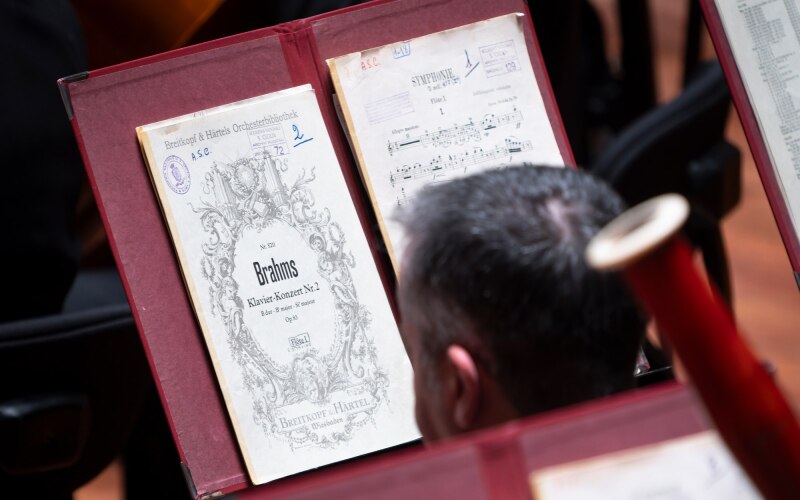
Lead photo: Daniel Harding and the Orchestra of the Accademia Nazionale di Santa Cecilia © János Posztós , Müpa Budapest