

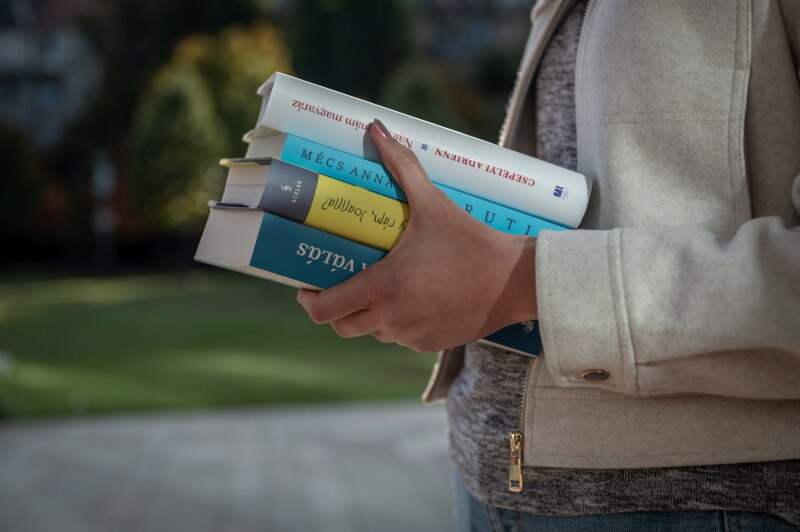
The Autumn Margó Literary Festival, an event of the Liszt Fest, will take place between 15 and 18 October at the National Dance Theatre, where you can meet Hungary’s leading authors and latest books, as well as the most exciting figures in contemporary world literature. We recommend ten books whose shows you shouldn’t miss. Here’s the list!
Bernardo Atxaga: Obabakoak (Typotex)
One of the guests we are the most excited to see at this year’s Margó Festival will be Bernardo Atxaga, who was born as Joseba Irazu Garmendia and is the best-known figure in contemporary Basque literature. Mysterious, genre-defying and hypnotic, his novel is set in a mountain village called Obaba, where nothing is quite what it seems. The son of a German mining engineer has a vision, a particularly humanlike wild boar makes an appearance, a writer investigates lizards, and the list of oddities goes on. At times lyrically beautiful and at others unsettling, the stories simultaneously emerge from the author’s early memories and from the jealously guarded legends of the secluded and enchanting Basque Country. If you love magical realism and enjoy venturing into distant worlds, then you absolutely must get hold of this book.
Tibor Bödőcs: Jézus a hegyen (Jesus on the Mountain; Helikon)
What would Jesus do if he were walking among us, and what would we do? What happens to a person after they die? What if there is another world – or, conversely, what should we do if nothing awaits us on the other side? Tibor Bödőcs’s latest novel tackles these conundrums and also poses, according to the blurb, the possibility of ‘a bucket of gherkins watching us from the sky.’ Or are they sun pickles? That’s not unimportant. Here’s another eagerly awaited volume by an author who made a name as a standup comedian, and whose book launch shows are guaranteed fun.
András Forgách: Papám (My Dad; Jelenkor)
Following Élő kötet nem marad (No Volume Spared) and Zehu, András Forgách publishes the last book of his prodigious family history trilogy. Papám (My Dad) tells the story of nineteen-year-old Marcell, who obtains a forged passport to emigrate from Transylvania to Palestine, where he enrols at university but later joins the British Army on the orders of the illegal Palestinian Communist Party. After four years of service, he falls in love with Bruria, a ‘goddess in the guise of a street urchin,’ and the two later go to Hungary to start a new life together. But is that even possible without mutual love? And how does the fate of a once-talented and courageous young man turn into a Greek tragedy? Follow the protagonist’s journey to find out.
János Háy: 100 nap (100 Days; Európa)
‘Open a hundred-day window onto your life, and you will recognize a lot things,’ suggests the blurb of János Háy’s latest book. 100 Days invites the reader to a thought-provoking and unforgettable journey. Not only does it offer insights into the trials, successes and failures of a writer’s life, but it also brings you to be mindful, almost willy-nilly, of the activities you spend your own time with. But really, what can you do in a hundred days? What happens to our feelings over a hundred days, what can we achieve, and what are we capable of in that time? You can read this book from cover to cover, like a novel, or you can jump between the days and paragraphs – the main thing is to throw yourself boldly into this shared adventure.
Balázs Mohácsi: Újabb narancsok gurulnak el (More Oranges Roll Away; Prae)
In some respects, Balázs Mohácsi’s book is a bona fide debut novel: a record of a poet’s transformation into a writer, as well as a coming-of-age story that reckons with both personal life and intricate cultural traditions. On the other hand, this work is much more than a classic debut volume of prose: it is an avant-garde experiment that pushes generic boundaries. More Oranges Roll Away is both a poem and a short story, an essay and a collage, autofiction and play, with important questions underneath the surface. What happens when a work loses its relevance after the death of the father? Can this sense of loss be overcome through literature? This novel is a scintillating chronicle of fathers, masters, the past and creativity, and is guaranteed to leave a lasting impression.
Anita Moskát: The Sound Restorer (A hangrestaurátor; GABO)
Increasingly popular in Hungary, Anita Moskát has recently also attracted significant international attention with a short story that won the British Science Fiction Association’s award. Her latest novel is set in a world where sounds, from speech to clattering, remain where they were produced. So when an explosion occurs in a fictional mountain range, the region has to be evacuated due to the persistent, unbearable noise. Sent by the government to locate the source of the disaster and resolve the problem, the two sound engineers who arrive at the scene are confronted with strange occurrences. We learn about the events in an unconventional way, through field diaries, and often have to deduce what is happening based solely on dialogue or sounds.
Beatriz Serrano: Discontent (Magvető)
Another exciting book from the world literature scene is Spanish author Beatriz Serrano’s novel El descontento (Discontent), which confronts us with early burnout and the reality of toxic workplaces. Have you ever felt like you’d do anything to avoid having to go to work? Or that, even though you have everything, you simply cannot feel happy? Then this book is for you. On the face of it, Marisa’s life couldn’t be more complete: she has a good job, she’s not alone, and she can even go on holiday from time to time. She has just one problem: she hates her job with all her heart, and finds it increasingly hard to endure the tedious hours spent at the advertising agency. Her anxiety is verging on the unbearable when a company team-building exercise brings an old memory to the surface, further complicating matters...
Kornél Szepesi: Betolakodók (Intruders; FISZ Books)
Kornél Szepesi’s debut novel boasts a meticulously constructed structure and a compelling narrative voice. Each story is apparently self-contained and has a distinctive atmosphere, but they all focus on the same question: what do you do with patterns of behaviour handed down in your family? Do you even have a chance to start with a clean slate, or does the past always repeat itself? Intruders features, among others, a young mother, a self-destructive artist and a man in a village for whom a night turns into a grotesque tragedy. Unsettling, sensual and experimental to an equal degree, this book has a lot to say about fathers, violence and the search for one’s path.
Kata Tisza: Oda nem illő (Out of Place; Scolar)
With her previous book, Kata Tisza brought a phase in her writing career to a close, and the latest novel heralds a new stage. Rebeka, the protagonist of Out of Place, has unique sexual fantasies that are difficult to fit into a society whose modus operandi is oversimplification. This is the story of a special, and consequently deeply lonely, woman who wants true connections but is constantly confronted with her outsider status. The author’s new books always attract enormous attention, and this one will be no exception, as we can all recognize ourselves in a work that focuses on the expression of living in freedom.
Gábor Vida: A bukfenc (The Somersault; Magvető)
Following the highly successful Egy dadogás története (Stammer Story) and Senkiháza – Erdélyi lektűr (Laoferville – Transylvanian Trash), Gábor Vida considers the eventful past from yet another angle. He now takes a deeply humane look at the inhabitants of a small town in Arad County, during the period from 1988 to 1992. And who are they? Hungarians, Romanians and others, but one thing is certain: they share more than just their hometown. They are bound together by a silent, collective knowledge of how to survive an extremely grotesque dictatorship that forms part of their everyday reality. But what happens to this community when the fall of the regime brings freedom – or its illusion?