

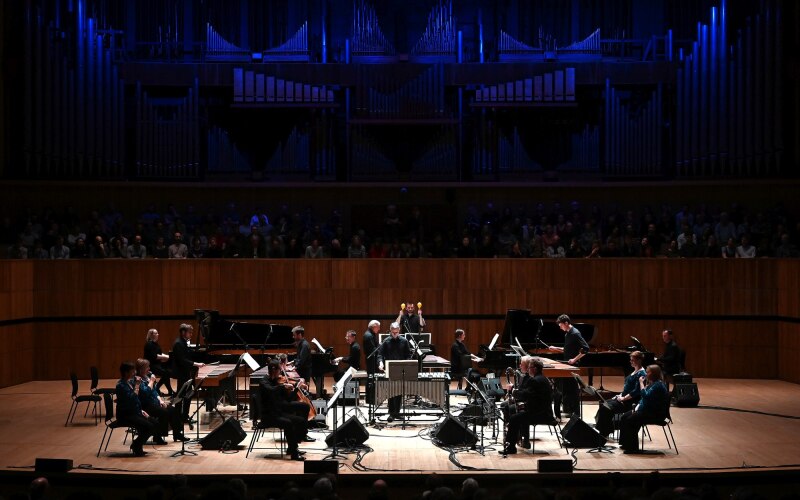
They set out with the intention of transforming London’s contemporary music scene so that most concertgoers could enjoy the latest works, not just a select few. Alongside the programmes, the success of their mission owed much to the high calibre of their concerts, and for over fifty years now, the London Sinfonietta has been one of the world’s leading ensembles of new music. On 12 October, the Budapest audience can hear them celebrate the ninety-year-old Steve Reich.
‘If I were the British Government, I’d declare the London Sinfonietta a national treasure... long may they continue to make new music,’ said Steve Reich, the world-famous American composer, whose music the same ensemble will soon play in Budapest. They will perform their programme, Steve Reich 90 at the Liszt Academy of Music, on 12 October.
Such praise was barely in the sights of those two 24-year-olds who in 1968 put together an orchestra (mostly from fellow Cambridge alumni) to perform The Whale, a dramatic cantata by their former classmate, John Tavener. Conductor David Atherton and Nicholas Snowman, who went on to become a highly influential arts manager, had grown tired of the fact that London’s contemporary music scene was of interest only to a small circle of people, and wanted to present new works to a high standard, in dialogue with older compositions. ‘We wanted to build a family: a family of musicians who enjoyed performing together and taking intense joy from it, particularly playing twentieth-century music,’ the conductor recalled the beginnings in an interview.
However, the musicians’ dedication alone would not have kept the London Sinfonietta in the stratosphere of contemporary culture for almost sixty years; it also took Nicholas Snowman’s extraordinary talent as an organizer. He won over supporters for their ambitious project with such persuasiveness that eight years later Pierre Boulez took him on board when he was to establish the Ensemble Intercontemporain. Those eight years also indicate how pioneering the London Sinfonietta was at the time.
The anarchic piece by Tavener, who was in his twenties like the Sinfonietta founders, was a great success, went on to be performed at the BBC Proms a year later, and was then issued by Apple, The Beatles’ label. The London Sinfonietta was now free to pursue its objective of performing the latest music with outstanding musicians and sufficient rehearsal time, to the same professional standard as the classics are usually performed.
Originally, contemporary music was not the only thing the ensemble would play: at its debut concert, alongside Tavener’s The Whale, Henze’s cantata Apollo et Hyazinthus and Richard Strauss’s Sonatina No. 2 were also on the programme. (The latter two, incidentally, had been composed only three years apart). Atherton continued to insist on this programming principle, believing that older works enabled listeners to approach new pieces with a fresh, open mind, without being put off by too many unfamiliar sonorities. When new music eventually prevailed in the concert programmes, the conductor left the ensemble.
Beyond being performers, the London Sinfonietta also plays a significant cultural role as the commissioner of over three hundred contemporary works to date, many of them from the greatest composers. In the early days, famous composers supported the orchestra by writing works for them, leading to the world premieres of Harrison Birtwistle’s Verses for Ensembles and Iannis Xenakis’ Thalleïn. Luciano Berio conducted his own works for an album released in 1977, while Karlheinz Stockhausen guided the ensemble through the premiere of his Ylem. The astonishing list of composers who wrote works for the London Sinfonietta (which you can browse here) includes Hans Werner Henze, Witold Lutosławski, Toru Takemitsu, Wolfgang Rihm, George Benjamin, Hans Abrahamsen and Magnus Lindberg, to name only a few.
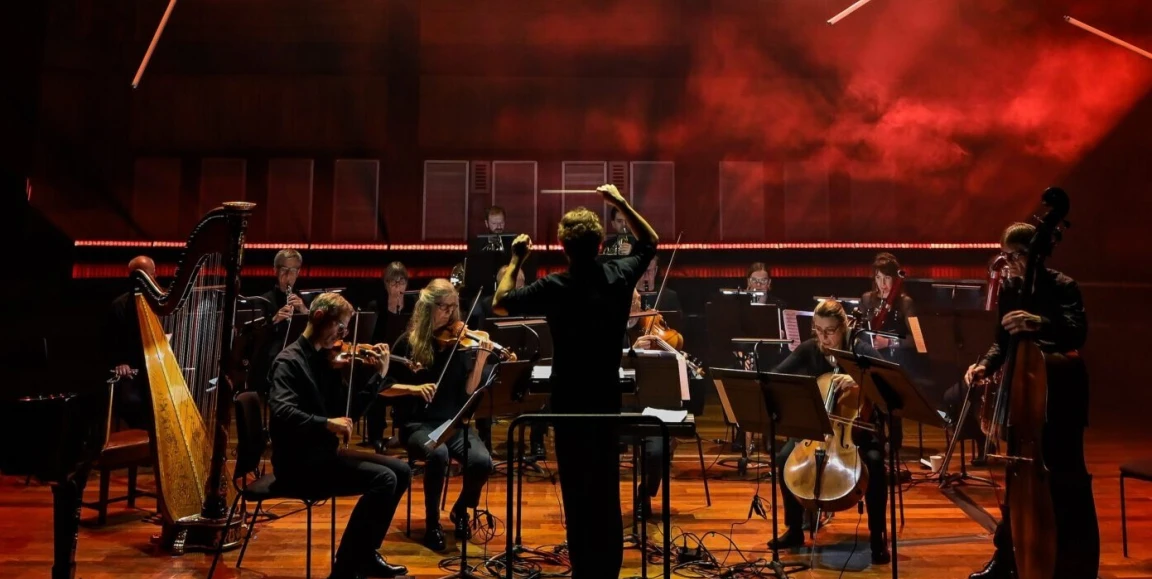
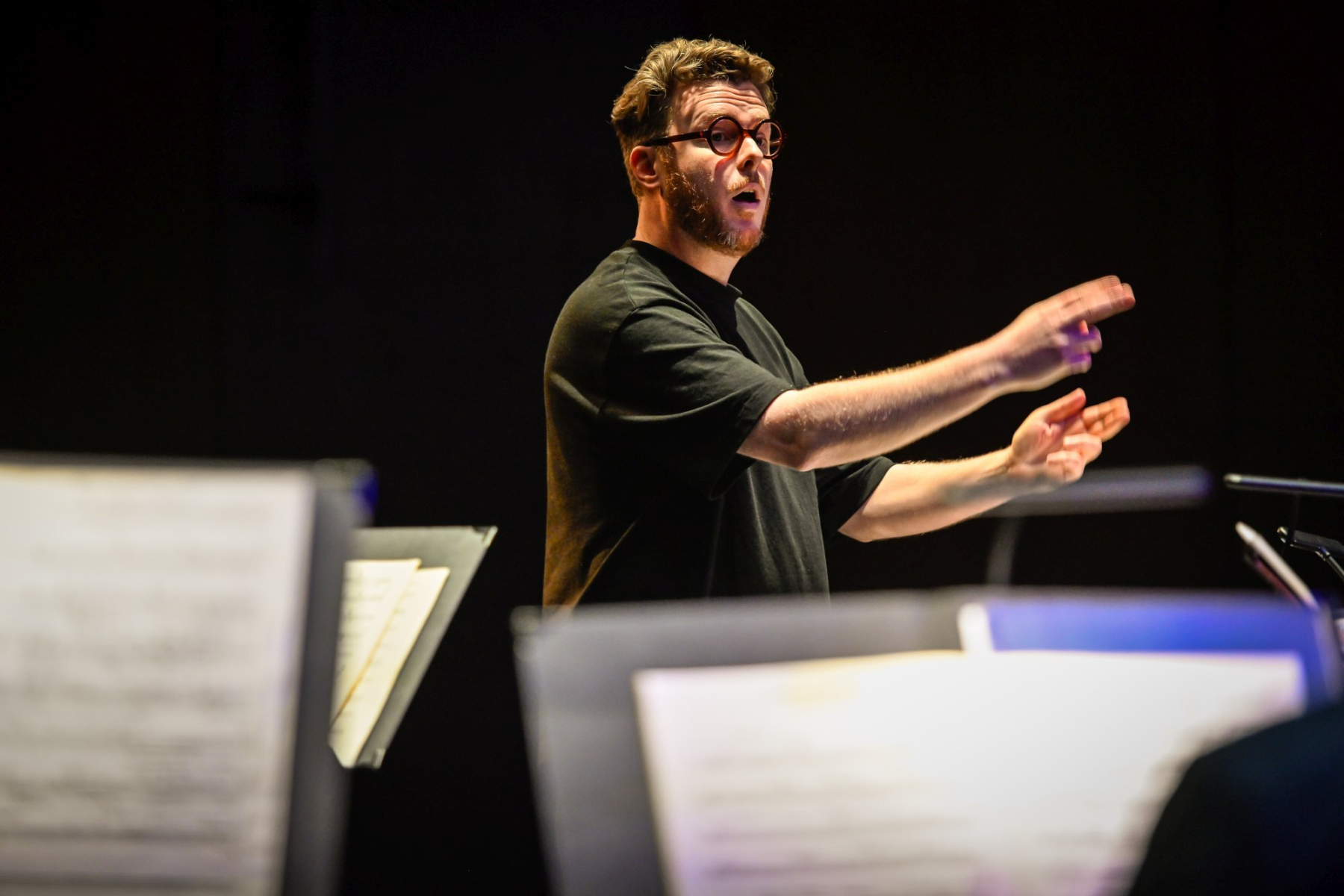 Toby Thatcher © Monika Jakubowska
When Atherton stepped down, Michael Vyner followed him as artistic director, before the founding conductor returned for a second term. Paul Crossley took over next, to be succeeded by Markus Stenz, whose name rings familiar in Hungary, especially on account of the premiere of György Kurtág’s first opera. The ensemble was later led by Oliver Knussen, Gillian Moore and Andrew Burke, though they also regularly perform with guest conductors. At their Budapest concert, for example, they will be conducted by Toby Thatcher, who, before taking up the baton, had played in the orchestra as an oboist. The London Sinfonietta is the resident ensemble of the Southbank Centre, though in 2008 they moved to Kings Place, a complex in central London, and now they regularly perform concerts at both venues.
In 2018, when the London Sinfonietta turned fifty, they looked back on the past in a special way, by associating an emblematic object with each year, from a concert brochure through Ringo Starr’s signature on a record deal and a poster from La Scala to a list of names from the first tour of Germany. One of the landmarks is a photo of György Ligeti, whose Chamber Concerto was premiered in England by the London Sinfonietta. (This treasure trove of a collection can be seen here.) The ensemble, which plays the latest music, has by now become part of the tradition itself, while critics continue to praise the liveliness and intensity of their performances. Just how these two qualities go hand in hand will become clear at the concert on 12 October.
Lead photo: Mark Allan