

Mary. For every Catholic, including Franz Liszt, this is a name steeped in mystery, for behind it looms the sorrowful face of the Mother of God, the Saviour’s mother. Numerous church feasts are dedicated to her; those who hold the rosary pray to her in particular, and the veneration surrounding her is so great that her name is taken not only by women but often also by men. It so happens that several Marys came to play a prominent role in the composer’s life. While the most important part, in my view, was played by the above-mentioned Virgin Mary, no small roles were also taken by Marie d’Agoult, the mother of the composer’s children, and Marie, the daughter of Princess Carolyne zu Sayn-Wittgenstein, another important companion in his life.
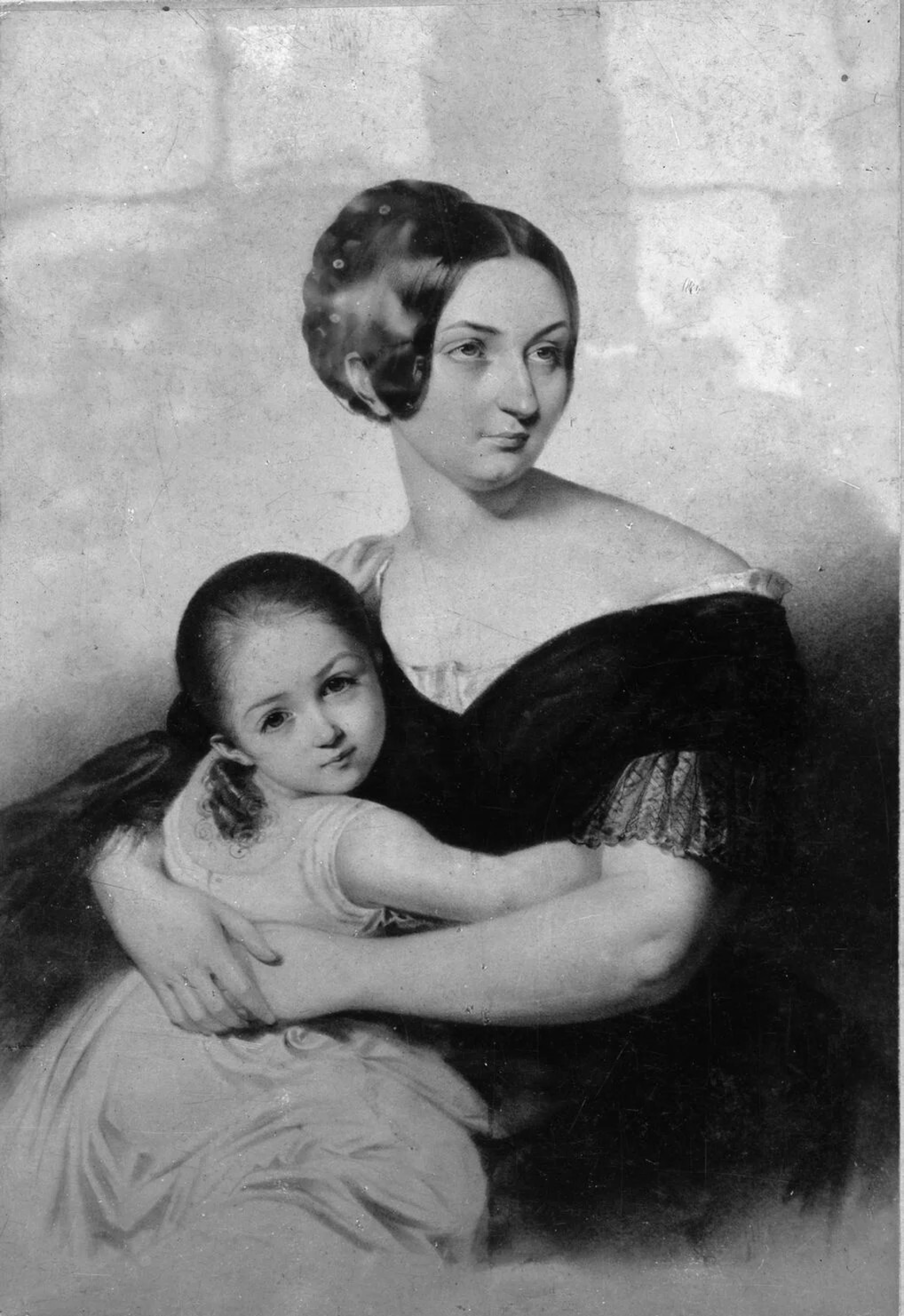
“For six years I lived amidst bleak constraints, in formless anguish; my barren and stifled life lacked light and fresh air, and so hopes I had cherished withered away, and the flame of my betrayed youth was extinguished.” This was how Mary no. 2 – the wife of Charles d’Agoult – recalled a period that looked glittering to the outside world but was grey on the inside. She enjoyed enviable financial security and had borne two charming girls for her loving husband, while servants took care of the burdens of bringing up the children and running the household. She was thus free to devote herself to organizing elegant soirées. Yet Marie was not happy and soon grew estranged from her husband, who was often away. But who was to blame? I hear your answer: the man! Indeed, this was long the prevailing view. In her memoirs, Marie blames Charles, while the literature on Liszt has also painted a rather dark picture of her husband. I didn’t live with them, thank God, so I don’t know who was right; nevertheless, an excerpt from a letter that Charles wrote after falling out with his wife testifies to precisely the opposite. I don’t know how many husbands today would be capable of reacting to a heated argument like this: “I hurt your feelings whilst you were ill, and that was not my intention at all! I was wrong to be so harsh with you; please forgive that angry outburst. As you said, which of us could not reproach ourselves? But you must know that there are times when I feel sad, because my wife and children mean everything to me, and nothing can take their place.”
Charles may well have made promises, including to stop watching football matches (obviously not), but neither the apology nor the vows convinced Marie, who was already looking for someone else. And so it was that she came across a “tall, excessively thin, pale-faced [man] with large, sea-green eyes in which a sudden light would gleam as when a wave takes fire, pained yet powerful features, an uncertain gait, seeming to glide rather than to touch the ground, with the absentminded, restless air of a ghost when the hour at which it must return to darkness is about to sound.” I suppose the very first sentence helps to identify the demonic figure who ensnared Marie as Franz Liszt. I do not wish to question the lady’s account, but it is worth noting that it was not the world-famous musician who seduced her, despite the assertions of so many people. While Liszt’s personality and piano playing did have a mesmerizing effect, he also strove to live an honourable life. And we should also remember that the time when the above lines were written, when the two enjoyed a relationship, was one of High Romanticism. I always smile at Marie’s story about an arduous crossing of a river, when all that really happened was that a large wave rocked the ferry on which they were travelling. Marie experienced it quite differently: “A wave even stronger than the previous ones struck our boat. I slipped and nearly fell backwards when an arm seized me and gently pulled me close, wrapping itself around my waist. ‘Marie!’ said the familiar voice. With his other hand, he held the wide lapel of his cloak, whose blood-red lining cast a crimson glow upon his pale, damp face, criss-crossed with sparse blue veins; his long, ash-blonde hair fell in soft waves upon his beautiful forehead, as if concealing the sparkle of his thoughts. He was beautiful and melancholy, like the angel of death who hovers above the bed of the righteous, and, fluttering his blue wings, gives them a breath of the eternal day that knows no night.”
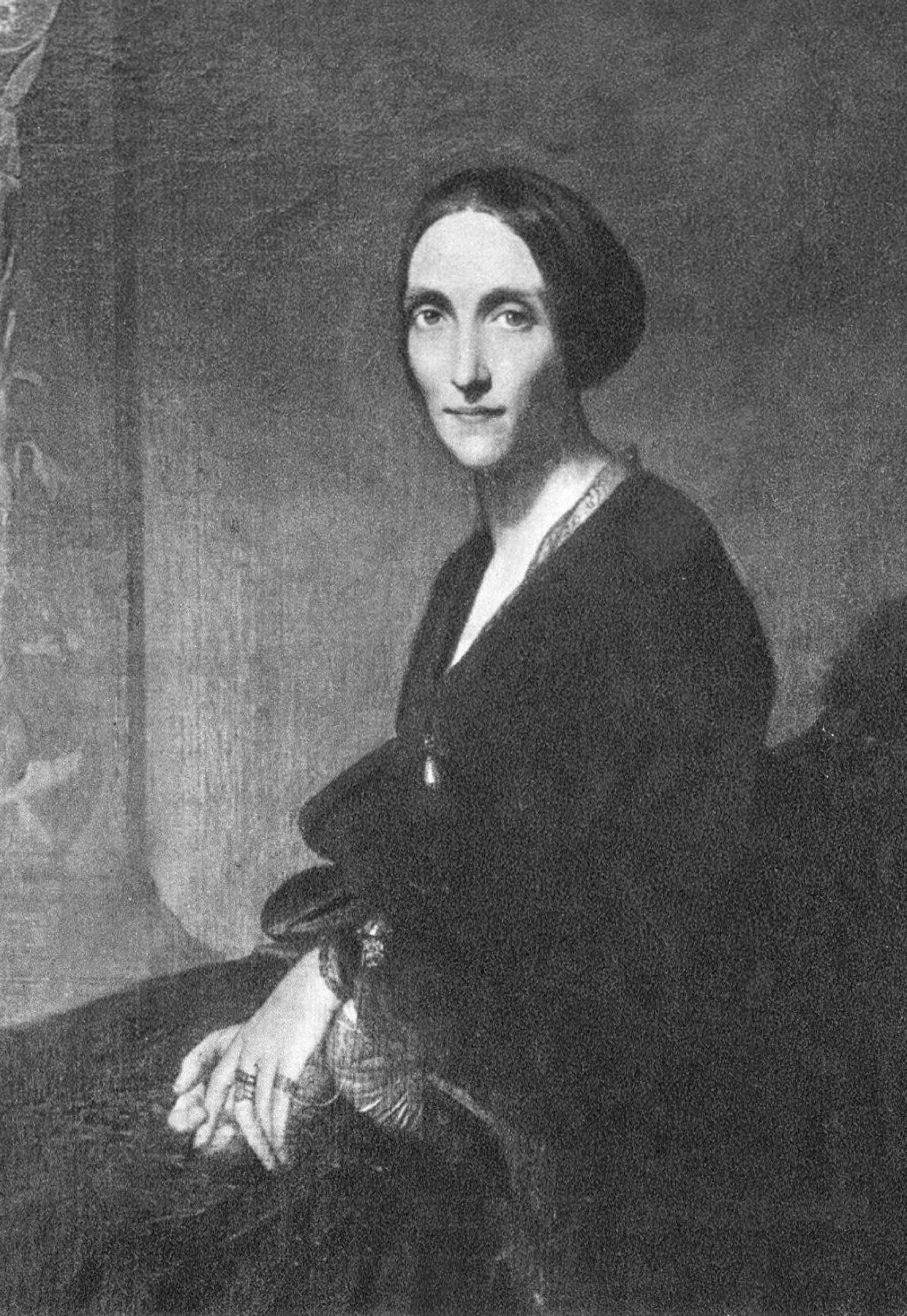
 Carolyn Sayn Wittgenstein / Forás: Klassik Stiftung Weimar
Marie D'Agoult, Flavigny grófnője / Henri de Lehmann
Liszt as the angel of death – we never saw that coming. But let us return to the love between Marie and Liszt. Their flaring emotions notwithstanding, the two did not immediately start to live together. Nor could they have done so, for Marie was an aristocrat and married with children, while Franz was a vagabond musician: two young people who were a poor match. So they agonized over their relationship, meeting and corresponding in secret. Perhaps they both had misgivings about the scandal that was to come their way, but neither of them suspected that a tragedy was brewing. Marie’s eldest daughter died from complications of an illness, causing the mother to break down: she believed that this was God’s way of punishing her for her sinful relationship with Liszt, that it was over and they would have to part ways. But there is no stopping love (especially Romantic love), so they met again, deciding to bid farewell to Paris together, come what may. “Where are we going? It doesn’t matter! Will we be happy or unhappy? How should I know! All I know is that it’s too late to want anything else. All I know is that I love you, and that I must break your shackles, and that we are one for ever, for better or for worse...,” Marie later recalled the final moments of that fateful meeting. The tragedy was duly followed by the scandal they had anticipated, which set the whole of Paris talking about them. During their years on the run, Marie bore Liszt three children (of whom the second, Cosima, would go on to uphold the family tradition of “love has to be scandalous to be good”). The relationship, however, did not last as their ill-matched temperaments proved irreconcilable. Given Marie’s erratic character and constant jealousy, set against Liszt’s wilfulness, unimaginable popularity and contrasting, sometimes fanatical religiosity, their separation was inevitable. They last saw each other in 1844; a love that lasted ten years. They lived fast.
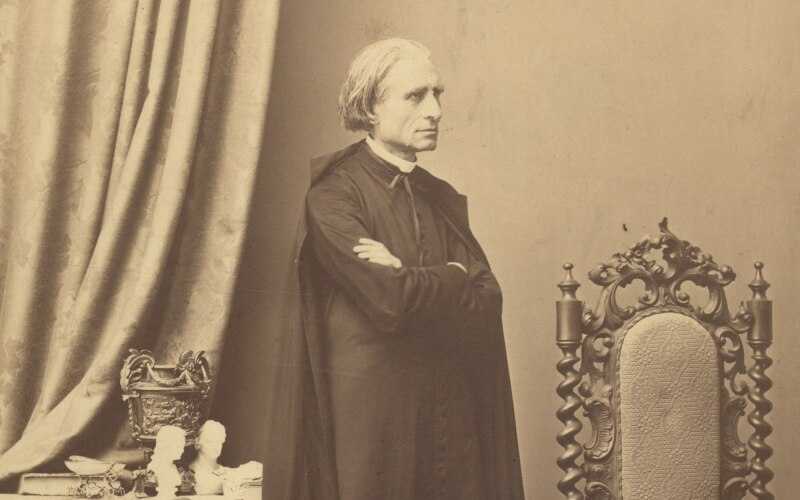
Whilst Marie d’Agoult was either unwilling or unable to grasp Liszt’s artistic mission, Princess Carolyne zu Sayn-Wittgenstein observed the composer and pianist’s performances with enthusiasm, openness and sensitivity. It was partly thanks to this appreciative interest that Liszt visited her with increasing frequency, and their relationship soon deepened. It is worth noting that while Liszt rarely dedicated works to the mother of his children, the new woman in his life “received” numerous pieces. Unfortunately, her own situation was similarly complicated: she was married and the mother of a daughter (the third Mary). Once they became intimate, they endeavoured to secure an annulment of her marriage because Liszt wanted a church wedding; he wanted to settle his account before God as well. The plan was for them to exchange their vows in Rome on the musician’s fiftieth birthday, but this never came to pass. Following a series of events that was tortuous even from the perspective of canon law, they gave up the fight; their relationship changed, they went their separate ways, and both chose instead to strengthen their ties with the Catholic Church. Carolyne wrote an astonishingly large volume of texts on ecclesiastical subjects, while Liszt officially committed himself to the church, temporarily retreating to a monastery, taking the so-called minor orders and donning a cassock. “Convinced as I was,” he wrote, “that this act would strengthen me on the right road, I accomplished it without effort, in all simplicity and uprightness of intention. Moreover, it agrees with the antecedents of my youth, as well as with the development that my work of musical composition has taken during these last four years – a work which I propose to pursue with fresh vigour, as I consider it the least defective form of my nature. To speak familiarly; if ‘the cloak does not make the monk’ it also does not prevent him from being one; and, in certain cases, when the monk is already formed within, why not appropriate the outer garment of one? But I am forgetting that I do not in the least intend to become a monk, in the severe sense of the word. For this I have no vocation, and it is enough for me to belong to the hierarchy of the Church to such a degree as the minor orders allow me to do.”
Liszt then moved to the Vatican, dividing his time between Rome, Weimar and Budapest, while, in a religious sense, he returned to the Mary he considered the most important in his life.
The article was originally published in the 2026 edition of Liszt Fest Magazine.
Lead photo: Canzi and Heller / Liszt Museum