


Franz Liszt was an experimental artist ahead of his time who sought new paths in music: he boldly experimented with sounds, forms and musical boundaries, and his solutions would seem innovative even decades later. The Liszt Fest evokes the same spirit of curiosity, the search for new paths and the crossing of boundaries.
The ELTE SuperSmartLab, which hosted an exclusive press conference ahead of this year’s festival, embodies the same philosophy in the teaching of chemistry. It is exploring new ways of bringing chemistry closer to students and the general public by incorporating state-of-the-art technologies, , digitalization and artificial intelligence.
It wasn’t a haphazard choice of venue: both the Liszt Fest and SuperSmartLab are about curiosity, discovery and pushing the familiar boundaries. One explores new avenues in the arts, the other, in science, and both invite the audience be more than observers, and take part in the discovery.
Just like the programme of the Liszt Fest, SuperSmartLab’s events for the general public are meant for those who are curious to find out what happens when a new perspective is offered on a familiar world.
The Chemists’ Flower Garden
Liszt was always driven by a desire to experiment and explore new possibilities: he took familiar musical elements as his starting point, but was not content with conventional forms. He sought out new sounds, new structures and new modes of expression, while allowing a musical idea to unfold, transform and occasionally lead him in quite unexpected directions.
 © Zsófia Pályi, Müpa
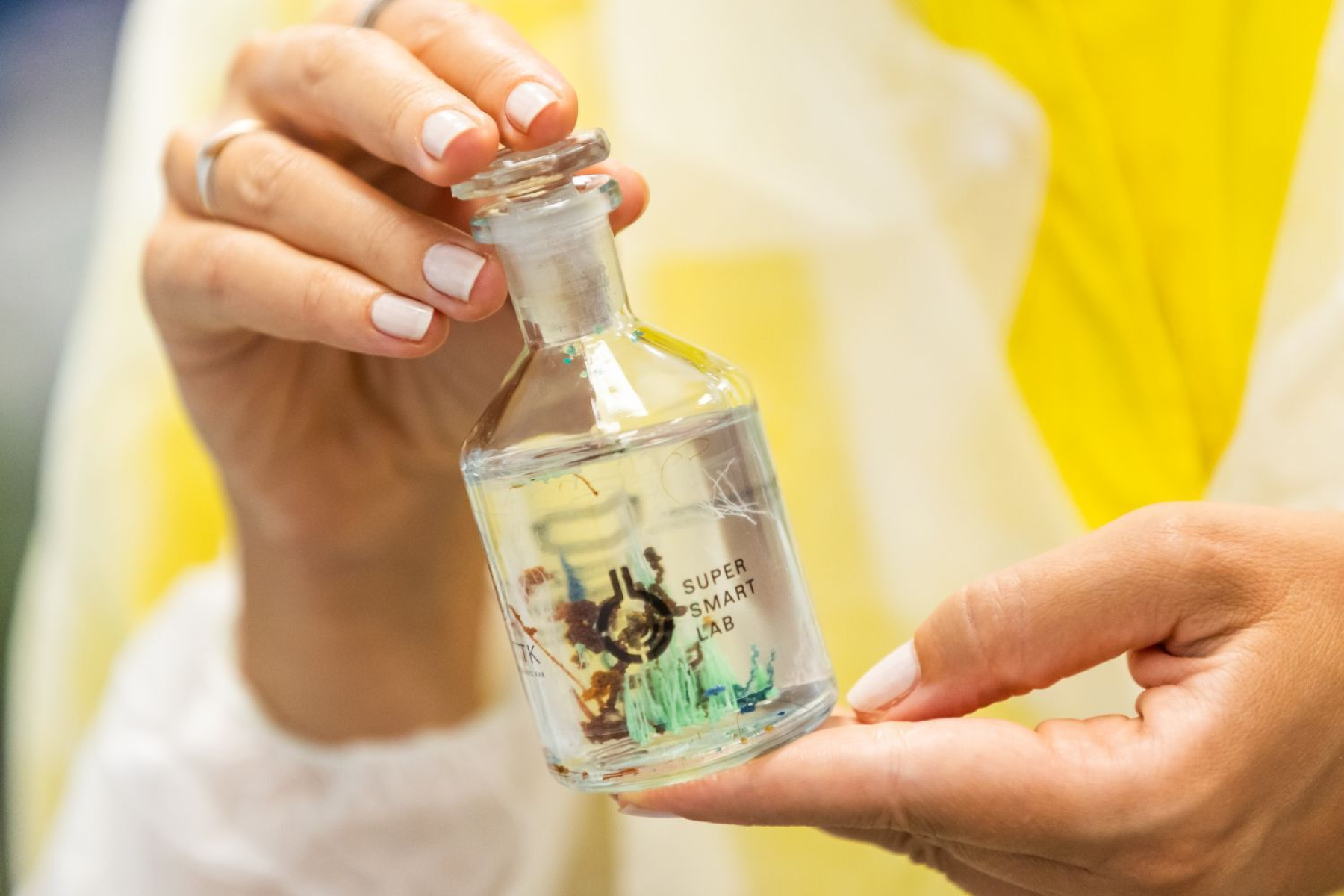
Like when you pour sodium silicate solution, in other words water glass, into a glass container, and then place crystals of different metal salts in it. When a metal salt comes into contact with water glass, an insoluble metal silicate is formed, which creates a thin, semipermeable membrane around the crystal. Through this membrane, water enters the space around the metal salt crystal, and the pressure that builds up there stretches the membrane outwards. The membrane cracks, and the solution flowing out from forms another metal silicate membrane with the water glass. The process keeps repeating, and the formations slowly grow upwards, branch out, and create strange, plant-like shapes in a matter of minutes.
Every metal salt produces a ‘plant’ of a different colour. The final result cannot be completely predicted: the chemist sets the initial conditions, but the chemical process itself determines the subsequent course of events.
Just as in Liszt’s works, no two creations in the chemist’s garden are exactly alike. The chemist initiates the process, but the form is shaped by the laws of nature.
Where Worlds Meet
The meeting of different musical worlds is one of the most distinctive characteristics of Liszt’s music. Songs with a Hungarian taste, romantic harmonies, church music, virtuoso piano technique and new, unusual musical solutions appear in the same oeuvre. Instead of simply juxtaposing these influences, he fashioned a new musical language from them.
 © ZsófiaPályi, Müpa
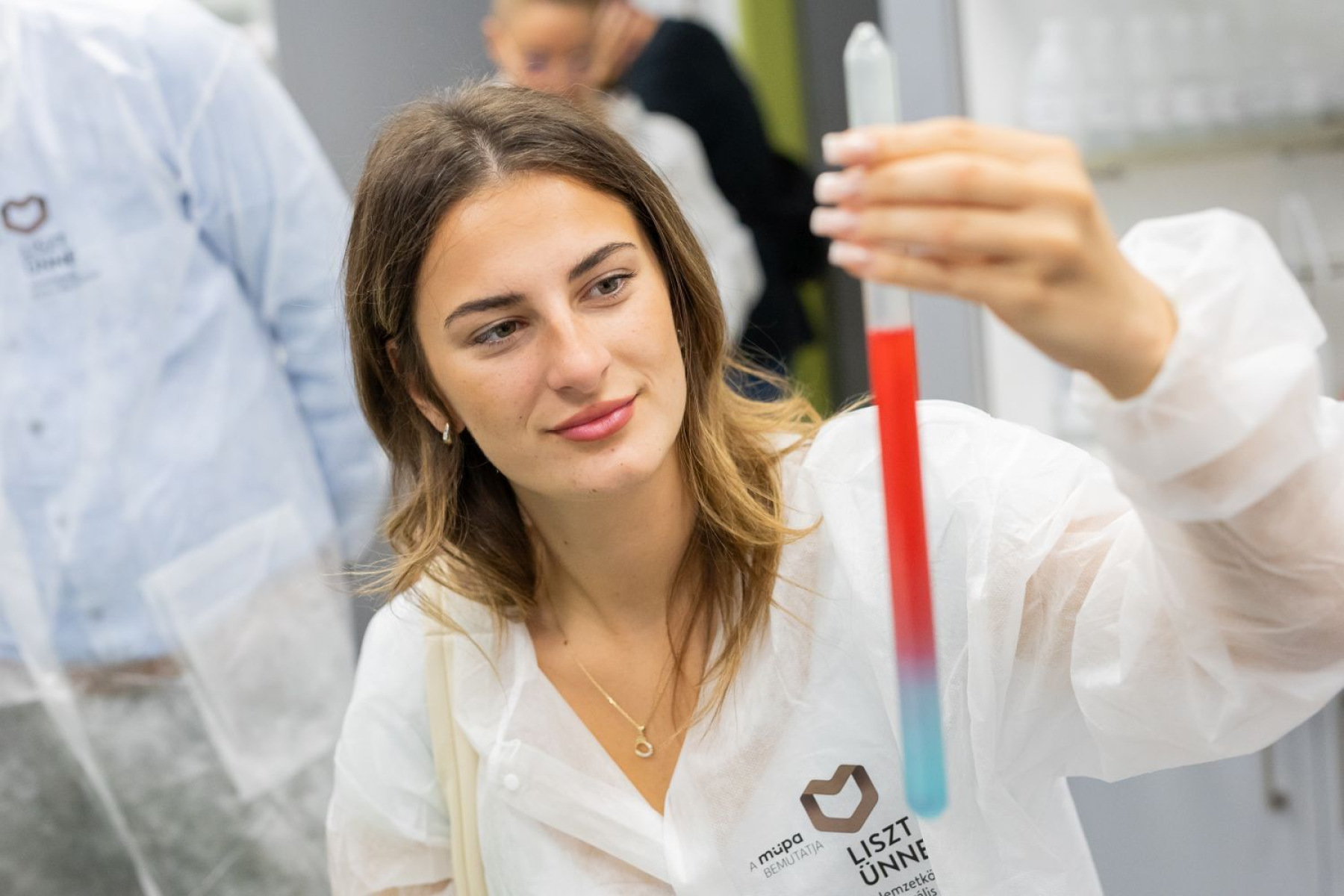
It is like combining three liquids with very different chemical properties in a sealed test tube. Shake the vessel, and for a moment everything will seem to be mixed up. However, once it is allowed to rest, the liquids will slowly separate and form three distinct layers. Some liquids mix, others remain separate. And because of their differing densities, they ultimately settle into separate layers, perfectly illustrating one of the essential aspects of Liszt’s art: different worlds can come together while retaining their own distinct character.
The Chemical Metronome
Rhythm and tempo never stop modulating the tension in Liszt’s music. In a chemical system, a distinctive ‘rhythm’ can be created by the change in the concentration of substances.
Oscillating reactions offer the most striking demonstration of this: the colour of the reaction keeps changing as the proportion of some substances changes periodically over time. Therefore, the reaction mixture also keeps changing colours. It is as if the chemical reaction had its own rhythm, creating an inaudible musical composition in which the notes are replaced by chemical processes.
 © Zsófia Pályi , Müpa
When Sounds Become Visible
For Liszt, the piano was an instrument whose possibilities he kept expanding. In addition to virtuosity, he sought out new sounds, techniques and musical forms. For him, music was not a fixed set of rules, but a world to be continually explored.
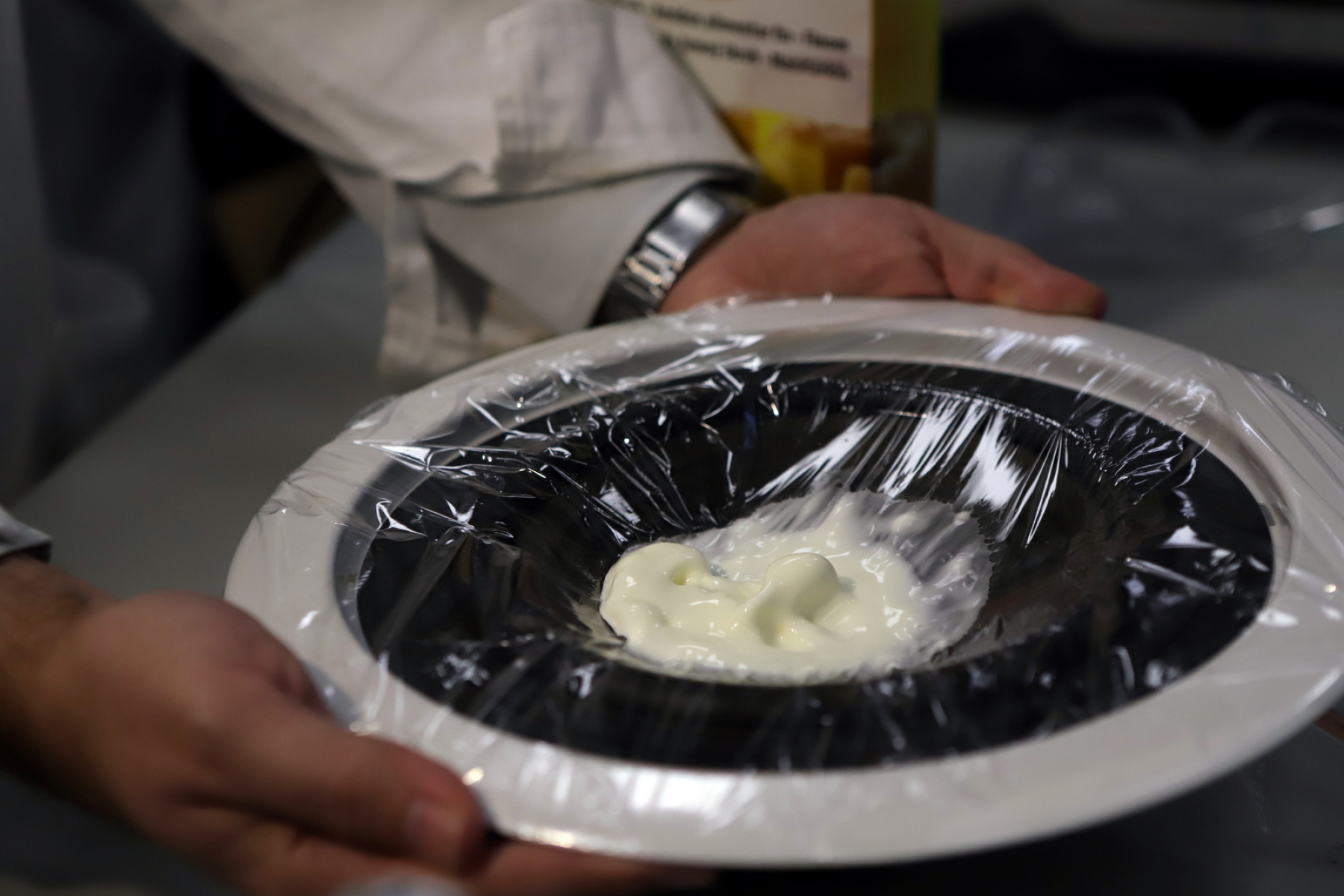
Not unlike the world of a non-Newtonian liquid, whose viscosity changes under external pressure. The mixture of corn starch and water is a common example of such liquids, and when it is poured on the membrane of a loudspeaker, it adopts the frequency of the membrane, creating different, ever changing shapes on the surface. If the frequency changes, the shapes will change; and if we add some powder on top, we can create an intriguing cloud of powder above it as well. If it were sculpted by the music. Music thus becomes very visible.
 © Gábor Rusznák , ELTE
The visualization of sounds (vibrations) actually goes back to the late 18th century, the work of Ernst Chladni, and the Chaldni patterns were a popular sensation by the time of Liszt.
Hungarian Colours
A true citizen of the world, Liszt also proudly embraced his Hungarian identity throughout his life. He particularly enjoyed experimenting with musical ideas in which a motif undergoes constant transformation while remaining recognizable.
But what does this remind a chemist of? Colours.
While with Liszt, Hungarian identity was most evident in music—the best-known examples are the Hungarian Rhapsodies—chemistry enlists acids, alkaline and indicators for the task. When its alkaline solution is added to three seemingly empty test tubes—each containing colourless pH indicators—the colours of the Hungarian tricolour emerge, depending on whether the respective indicator solution is acidic or alkaline.
 © Gábor Rusznák , ELTE
Something similar takes place in Liszt’s music: the same melody or musical motif (sodium hydroxide) can take on a completely different character, depending on the harmonies, timbres and musical environment surrounding it (indicator solution). And if contemporary anecdotes are anything to go by, Liszt ‘suffered’ from synaesthesia, seeing different colours when hearing different sounds.
(Víkingúr Ólafsson, himself a synaesthete, has talked about the phenomenon in several interviews.)
Lead photo: Zsófia Pályi, Müpa