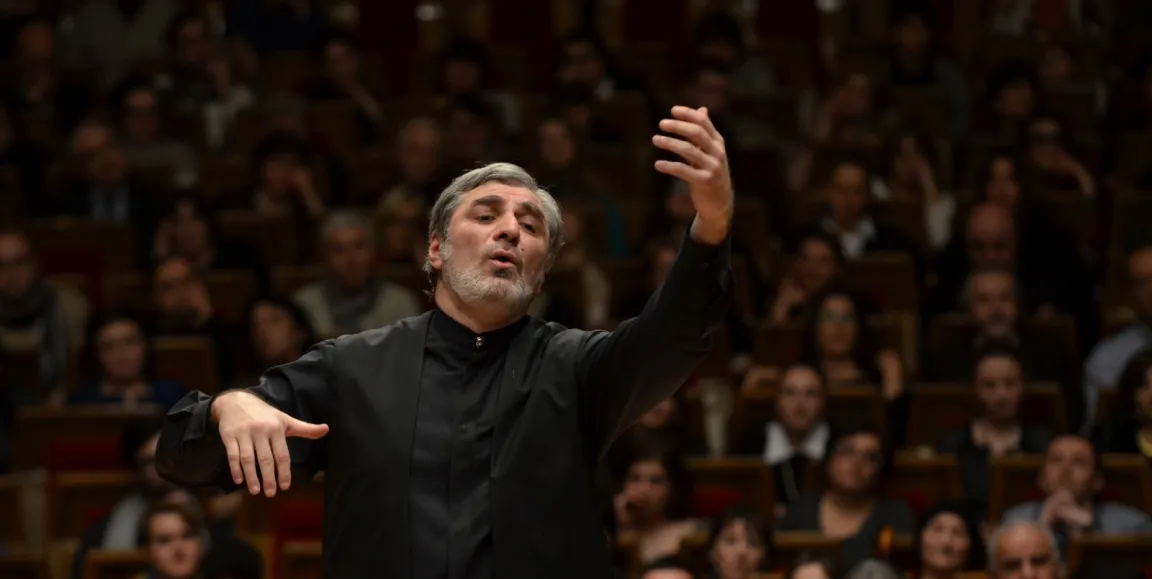


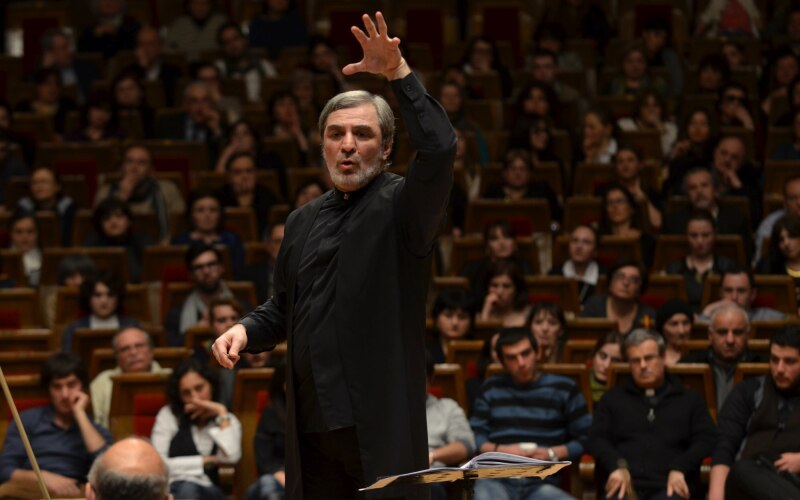
If one were to list Georgia’s most significant musicians, Vakhtang Kakhidze’s name would certainly feature in the top five. In the career of the 67-year-old artist, conducting and composing have been closely intertwined from the beginning, although he himself considers the latter to be his primary vocation. He is coming to Müpa Budapest with his grand Requiem.
Kakhidze was born in Tbilisi in 1959 and was surrounded by music from a young age: his mother was a pianist, while his father, Jansug Kakhidze, was a famous conductor, known as the ‘Georgian Karajan.’ He began playing the piano at the age of six, and went on to study choral conducting at secondary school. He enrolled at the Tbilisi Conservatoire to study composition, but after a year he transferred to the Moscow State Conservatory, from which he graduated in 1981. His teachers included such eminent composers as Nikolai Sidelnikov and Edison Denisov.
He gained experience in conducting as an assistant to his father, who was principal conductor of the National Opera and Ballet Theatre of Tbilisi. Kakhidze made his debut at the theatre with his own work, The Amazons, a ballet that remained in the repertoire for four seasons. In 1993, Jansug Kakhidze founded the Tbilisi Symphony Orchestra, which he led until his death in 2002; since then, his son has been at the helm of the ensemble. He is also artistic director of an institution, the Jansug Kakhidze Tbilisi Centre for Music and Culture, which is named after his father. For Kakhidze, it was a matter of course to carry on his father’s legacy: ‘It wasn’t difficult to follow in my father’s footsteps, because we have very similar views on music. And I always bear in mind that my first vocation is composition, which is why I try to strike a balance between conducting and composing,’ says the artist.
His work as a composer is extremely diverse; in addition to having composed numerous classical pieces, he also creates music in the genres of jazz and pop, as well as writing music for stage productions and films. He believes that, rather than one getting in the way of the other, his pieces in different styles perfectly complement one another. ‘Composing music for film, for example, is a completely different process from writing classical music, which is why I am very grateful for the opportunity to create such a wide range of works.’
A Requiem in Memory of His Parents
As if this diversity were not impressive in itself, Kakhidze has also been closely connected to Georgian folk music since childhood. ‘Georgian folk music is ancient, unique and extremely varied, as the western and eastern traditions of the country are very different,’ the composer points out. This distinctive musical world also comes to inform his Requiem: certain sections bear a strong resemblance to Georgian folk music, though none are direct quotations. Kakhidze began writing his Requiem in 2020, following the outbreak of the Covid pandemic, and completed it in the space of about two months. The work comprises fifteen movements and is based on the structure of the Catholic Mass. The text is consequently Latin in most part, though some sections are sung in Georgian. The piece is made even more personal by the fact that he dedicated it to the memory of his parents.
The world premiere took place in Tbilisi in 2022, and since then it has been performed to great acclaim in Antwerp, Ankara and Athens. The work, which requires a massive performing force, can be first heard in Müpa Budapest on 17 October 2026. The boy soloist, Levente Regő Rácz, will be joined by two Hungarian choirs, the Cantemus Mixed Choir and the Budapest Academic Choral Society, while the Rustavi Ensemble and the Chanters Quartet will be responsible for creating the authentic Georgian sound. The musical accompaniment will be provided by the Budafok Dohnányi Orchestra, with whom Kakhidze has been working regularly for several years. ‘I have visited Hungary on several occasions: I have performed at the Academy of Music and at the Zemplén Festival at the invitation of Gábor Hollerung. In fact, last year I composed a piece (entitled ‘Congratulations!—ed.) for the Budapest Saxophone Quartet, which is celebrating its 30th anniversary, and we premiered it in Budapest,’ recalls the artist, adding that he is very much looking forward to this year’s concert. Because some of the performers are Hungarian and others are Georgian, this collaboration is special for him.
Georgia’s Most Prestigious State Honour
We have focused on his work as a composer, but we must also make mention of his career as a conductor, because, in addition to his own orchestra, he has conducted ensembles such as the Prague Symphony Orchestra, the ‘New Russia’ Symphony Orchestra, the Beijing Symphony Orchestra, the Israel Chamber Orchestra and the choir and orchestra of the Church of the Holy Trinity in Paris. He also maintains a close working relationship with Gidon Kremer and the Kremerata Baltica, which the world-renowned violinist leads: the orchestra’s album Happy Birthday features one of Kakhidze’s compositions. The numerous other renowned performers he has shared the stage with include the violist Yuri Bashmet, the opera singer José Carreras, the oboist François Leleux and two of his compatriots, the violinist Lisa Batiashvili and the soprano Nino Machaidze. In addition to his concerts, he has produced 25 records for international labels. The album My Heart Speaks, which he recorded with pianist Ivan Lins and the Tbilisi Symphony Orchestra, was nominated for a Grammy Award in 2024.
His multifaceted body of work has been recognized with several prestigious awards: he has received the Georgian Theatre Union Award for Best Theatre Music on three occasions (1998, 2005, 2013). In 2000, he was awarded the Order of Honour of the Republic of Georgia, and in 2010 and 2021, he received the Shota Rustaveli Prize, which is considered the highest honour in the arts in the country.
Before coming to Müpa Budapest, Kakhidze will be conducting at the 34th International Music Festival ‘Autumn Tbilisi,’ of which he is artistic director. This year’s programme is centred around the major anniversaries of three composers: Mozart, Shostakovich and Andria Balanchivadze. Kakhidze’s season will continue to be largely taken up by conducting engagements, but whenever he has a little spare time, he loves to devote himself to his ‘primary vocation’, composing.